
"He's coming home."
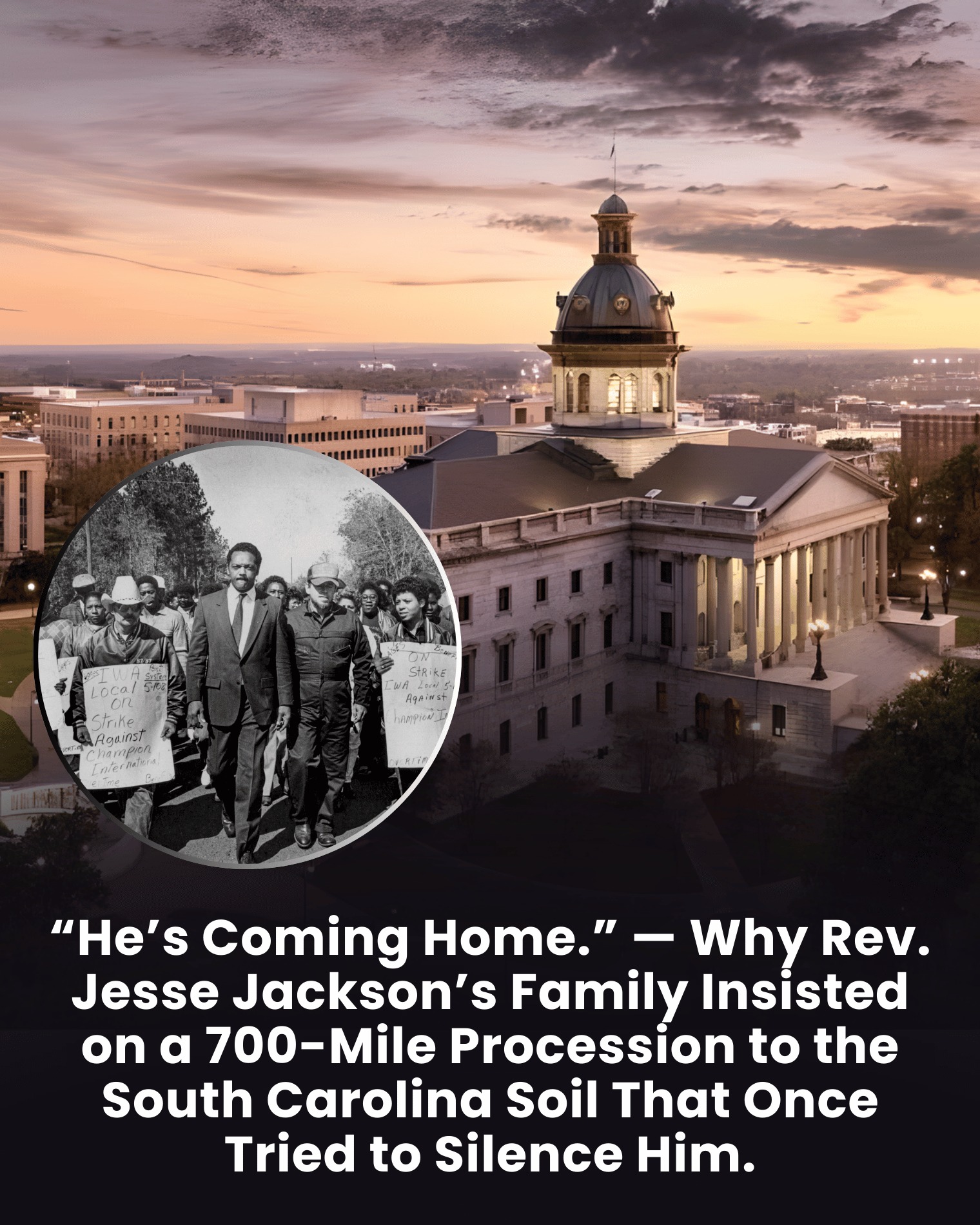
For the family of Jesse Jackson, those three words carried the weight of history. The decision to transport his casket more than 700 miles from Chicago back to Greenville, South Carolina, was not about geography. It was about legacy.
The road south traced the arc of a life that began under the rigid shadow of segregation. In 1960, as a young college student filled with conviction, Jackson was arrested in his hometown for attempting to enter a whites-only public library. The act was simple. He wanted to read. The response was swift. In the Jim Crow South, that desire alone was considered defiance.
Greenville's soil once symbolized restriction — a place where doors were closed not because of character, but because of color. That early confrontation with injustice helped shape the man who would later stand alongside Dr. Martin Luther King Jr., organize boycotts, run for president, and become one of the most recognizable voices in the American civil rights movement.
Decades later, as dawn broke over Chicago and the procession began its solemn 6 a.m. departure, Jackson's family remained unwavering in their request. He would not remain solely in the city where he built his national platform. He would return to the ground where his courage first collided with cruelty.
The symbolism was unmistakable.
The 700-mile journey was more than a funeral route. It was a reversal of history. In 1960, he was escorted away in handcuffs for crossing an invisible line. In his final procession, he crossed state lines with honor guards, tributes, and reverence. The boy once barred from a library would return as a figure whose life altered the nation's moral vocabulary.
Family members described the decision as essential. To them, Greenville was not simply a birthplace. It was the origin point of resistance. Every speech he delivered, every march he joined, carried the imprint of that early humiliation — and the resolve it ignited.
The South Carolina landscape he returned to is not the same one that tried to silence him. The laws that enforced segregation have long been dismantled. Public libraries stand open to all. The contrast between 1960 and today underscores the transformation Jackson helped accelerate.
For those lining portions of the route, the procession felt like a living history lesson. Elder residents remembered the era when young activists were jailed for demanding access to public spaces. Younger generations, raised in a different America, witnessed the closing of a chapter that began before they were born.
Bringing him home also anchored his story in a tangible place. Civil rights history often unfolds in textbooks and documentaries, but it is rooted in streets, buildings, and soil. Greenville was the stage of his first public stand. It was only fitting, his family believed, that it would host his final rest.
In the end, the journey was less about distance and more about dignity. The same earth that once rejected him would now receive him with honor. The same town that once enforced silence would now echo with remembrance.
"He's coming home" was not just a statement of logistics. It was a declaration of triumph.
The boy who dared to read returned not as a prisoner, but as proof that courage, once planted, can outgrow the very barriers meant to contain it.