
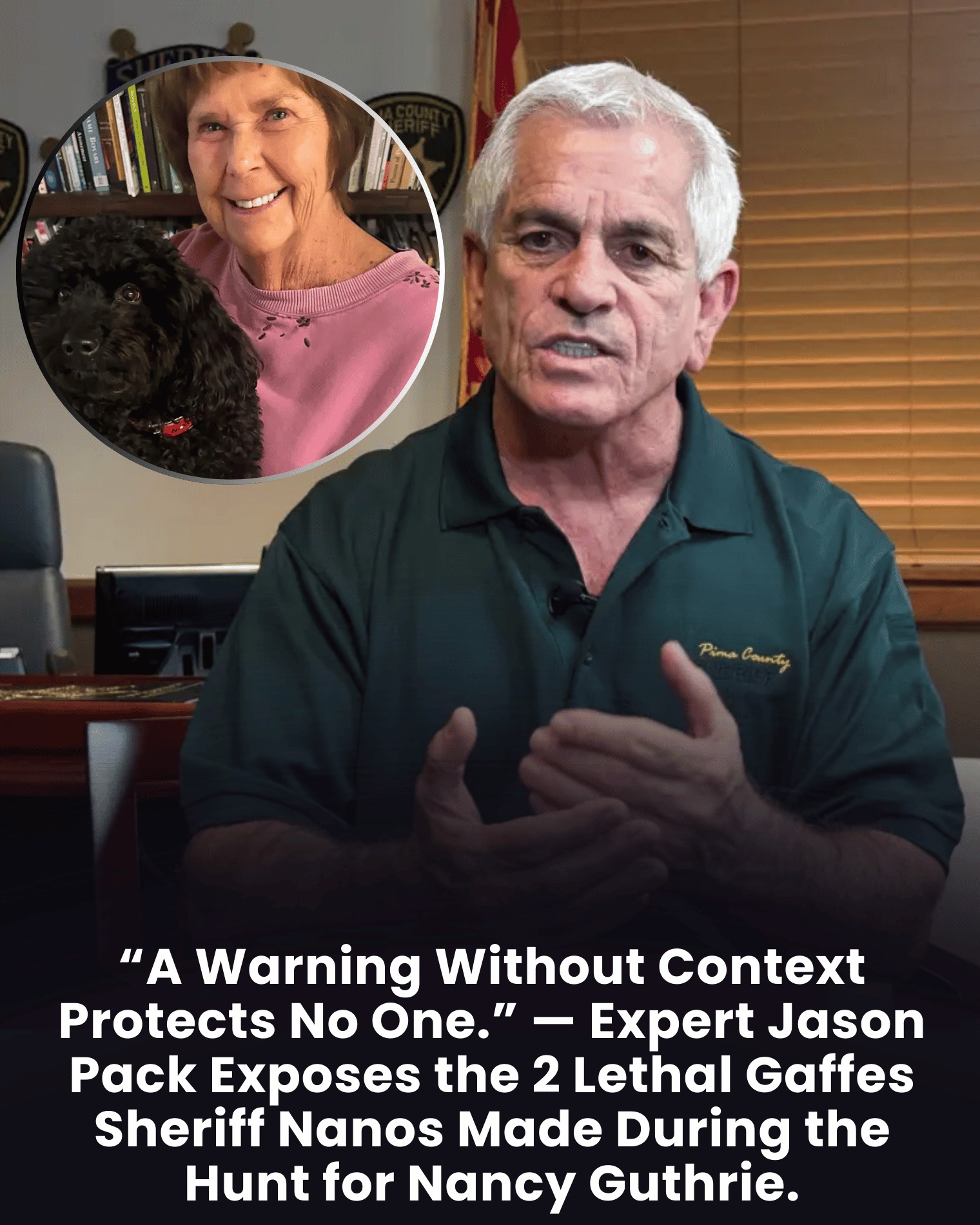
The most dangerous kind of public warning is the one that raises terror without offering protection. That is the haunting idea at the center of the latest criticism aimed at Sheriff Chris Nanos during the search for Nancy Guthrie, a case that has already left the Tucson community rattled. According to expert Jason Pack, two devastating communication failures turned an already frightening situation into something even worse: public panic without public guidance.
The emotional weight of that failure is captured through the image of Hoda sitting in her dressing room, trembling as she watches the sheriff's press conference unfold. For someone with more than 15 years in news, she immediately recognized the signs of a briefing gone wrong. This was not simply a matter of officials being cautious with details. To her, it looked like a warning delivered in the most destabilizing way possible—strong enough to frighten everyone, but too vague to help anyone.
That tension appears to be exactly what Jason Pack seized on in his analysis. His central argument is brutal in its simplicity: if law enforcement suggests an attack was "targeted," hints at an ongoing threat, and still refuses to explain what kind of threat the public should actually be watching for, then the result is chaos. Families hear the alarm, but they are given no practical way to respond. Parents do not know whether to keep children home, women do not know whether to avoid walking alone, and neighbors are left scanning every street corner with no clue what danger looks like.
Pack reportedly identified two lethal gaffes in the sheriff's handling of the moment. The first was invoking fear without context. Once the public hears language suggesting a serial threat or a broader pattern, people naturally assume the risk could extend to them. That assumption spreads quickly, especially in a community already on edge. Yet if officials stop short of clarifying the suspected motive, victim profile, or circumstances, the fear becomes shapeless. And shapeless fear is often the hardest kind to control.
The second mistake was failing to pair warning with actionable advice. Public safety briefings are supposed to do more than inform; they are supposed to equip. Even when investigators cannot reveal every sensitive detail, communities still need some form of practical instruction. Should residents travel in groups? Avoid certain areas? Report a particular vehicle or behavior? Lock down schools? Increase patrol awareness? Without that bridge between concern and action, the warning becomes emotionally explosive but strategically empty.
That is why Pack's criticism hits so hard. His conclusion, summed up in devastating terms, is that the sheriff created a "100% panic rate with 0% actionable advice." It is the kind of phrase that lingers because it captures exactly what so many people fear in real time: being told something terrible is happening, but not being told how to survive it.
For Hoda, the press conference was not just frustrating—it was a textbook example of how officials can lose public trust in the very moment they most need it. Her whispered reaction, "He's scaring people without giving them a shield," cuts deeper than any formal media critique. It speaks to the emotional contract between law enforcement and the public. If leaders are going to ask a city to stay alert, they also owe that city clarity, direction, and calm.
In a crisis, words matter as much as sirens. A warning without context does not protect a community. It leaves that community suspended in fear, waiting for answers that should have come with the first alert.